Blog alternatives
Zyn Alternatives: Nicotine-Free Pouches and Other Options

You are not ready to go to zero tomorrow, but you are done pretending the tin is harmless. So you search for alternatives, and the results are a wall of products that all want to be your new tin. Here is the honest version of that list: what each option actually replaces, what the evidence says, and which swaps are not improvements at all.
Quick answer
The alternatives to Zyn fall into four groups. FDA-approved nicotine replacement (gum, lozenge, patch) replaces the nicotine with a regulated, step-down dose. Nicotine-free pouches replace the lip habit, not the nicotine. Lower-strength pouches are a taper step, not a destination. Vaping and dip are sideways moves. The only alternative that ends the habit is zero.
Key takeaways
- Separate what you are replacing: the nicotine, the ritual, or both. Most people need a plan for each.
- Nicotine replacement therapy is the option with evidence. smokefree.gov says research shows it is safe and effective and that it can more than double your chances of quitting.
- Nicotine-free pouches are useful for the lip habit and useless for withdrawal. Know which job you are giving them.
- A lower-strength pouch is a taper move. The CDC says there are no safe tobacco products, including nicotine pouches, so "weaker" never means "fine".
- Nothing here is a recommendation to use pouches as a quit aid: the FDA has not approved any pouch for that, and Truth Initiative says pouches are not a recommended way to quit nicotine in any form.
What are you actually trying to replace?
A pouch habit is two habits wearing one coat. There is the nicotine, which your brain now expects on a schedule, and there is the ritual: the tin in the pocket, the tap, the lip, the twenty small moments a day when your hand knows what to do. Quitting fails most often when a plan covers one and ignores the other.
So before you shop for an alternative, split the question. For the nicotine, you want something that delivers a known, regulated dose that you can step down. For the ritual, you want something your lip and hand can do that does not come with nicotine attached. For some people a single product covers both for a while (nicotine gum does); for most, the answer is a pairing.
Our how to quit Zyn guide walks through building that plan. This guide is the map of the options.
Option 1: Nicotine replacement therapy (gum, lozenge, patch)
Nicotine replacement therapy (NRT) is the group of over-the-counter and prescription medicines made to help people stop using nicotine: the patch, gum and lozenge you can buy at a pharmacy, and the inhaler and nasal spray a doctor can prescribe. smokefree.gov describes how they work: a small, controlled amount of nicotine, without the other chemicals in cigarettes, to reduce withdrawal and the urge to use. It says that "research shows that NRT is safe and effective" and that NRT "can more than double your chances of quitting."
For pouch users, gum and lozenges are the natural fit. They live in the mouth, so the ritual survives; they come in a labeled dose with a step-down schedule printed on the box; and they are the fast-acting kind of NRT that a 2019 Cochrane review found helps people who cut down gradually (the review pooled studies of smokers, so read across with care). Truth Initiative, which does not recommend pouches as a quit aid, points people the same way and suggests lower-dose NRT such as lozenges or gum as a way to taper off pouches.
Three honest notes. The labels are written for smokers, so ask a pharmacist, a doctor or the free quitline how to think about dose from your pouch count; this guide will not pick one for you. NRT will not remove every urge; smokefree.gov says to pair it with a plan. And if you are pregnant or breastfeeding, have a heart condition or take medication, talk to a doctor before starting it.
Our guides on nicotine gum and lozenges to quit Zyn and quitting Zyn with nicotine patches go through each product, and nicotine pouches vs nicotine gum compares the two kinds of product directly.
Option 2: Nicotine-free pouches
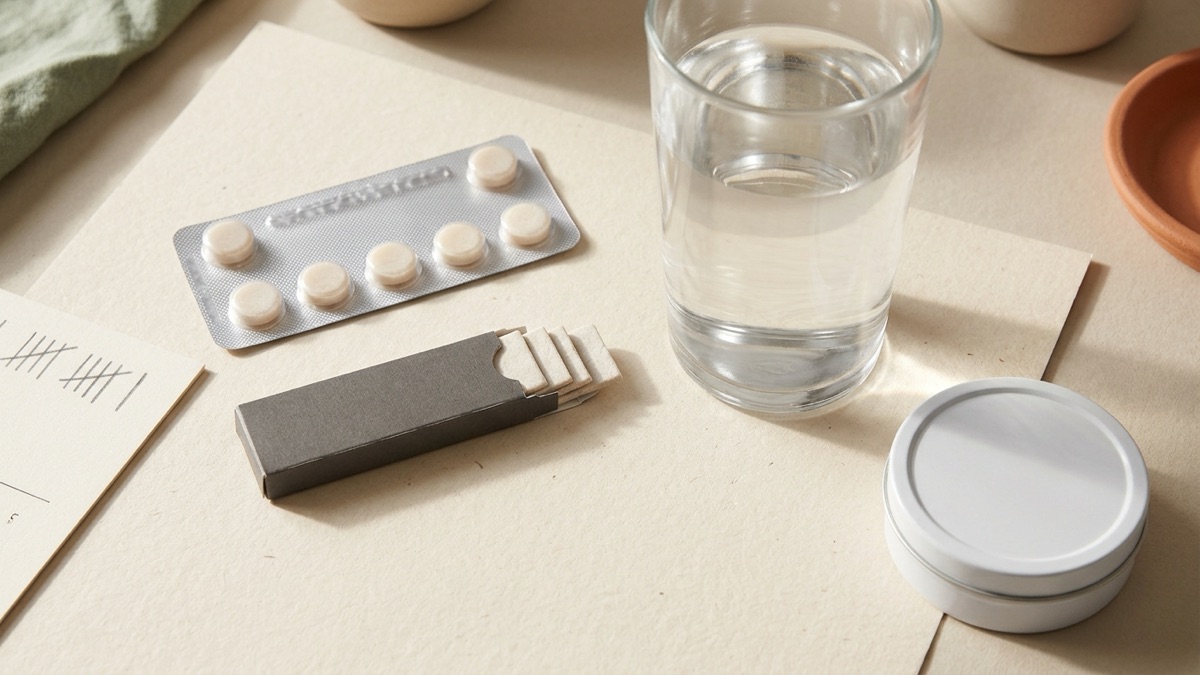
A nicotine-free pouch looks and feels like the thing you are quitting: a small white pouch of plant fiber and flavoring, sometimes with caffeine or other additives, that sits under your lip. It contains no nicotine, so it does exactly one job: it gives the ritual somewhere to go.
That job matters more than it sounds. The lip itch at 9 a.m. is real, and a nicotine-free pouch answers it without feeding the dependence. What it cannot do is anything about withdrawal. If your plan is "switch to nicotine-free tomorrow," you have planned a cold-turkey quit with a prop, and you should plan the first 72 hours accordingly, ideally with gum or a lozenge on hand for the nicotine side.
Two cautions. First, "nicotine-free" is a claim on a label, not a regulated category, so read the ingredient list and buy from a seller who shows one. Second, these are still pouches sitting on your gum for hours; the dental literature on pouches is about nicotine pouches, and nobody has studied nicotine-free ones at length, so rotate the spot and watch your gums the same way. Our guides to nicotine-free pouches and the best nicotine-free pouches for quitting cover what to look for.
Option 3: A lower-strength pouch, as a step
If you use 6 mg pouches, a 3 mg pouch halves your nicotine while every other part of the habit stays the same. That is the first move in a taper, and for heavy users it is often the move that makes the rest feel possible. Our taper schedule guide explains the strength-first method.
What it is not is an alternative in the sense people mean when they search this. A lower-strength pouch is still a nicotine pouch. The FDA's January 2025 authorization of some ZYN products found they contain substantially lower amounts of harmful constituents than cigarettes and most smokeless tobacco products, and the same announcement said plainly that authorization "does not mean these tobacco products are safe." The CDC says there are no safe tobacco products, including nicotine pouches. Treat the lower strength as a rung on a ladder you are climbing down, with a quit date at the bottom.
Try it
The free nicotine taper calculator builds that ladder from your pouches a day and strength, switching you to lower strengths before it cuts your count, and gives you a quit date.
Option 4: The swaps that are not improvements
Some "alternatives" move the nicotine around without reducing it.
Vaping. People who came to pouches from vaping sometimes drift back, or try to run both. Truth Initiative notes that using pouches alongside other nicotine products increases addiction risk and makes quitting harder. If the goal is out, a vape is sideways. Our guide is Zyn better than vaping compares the two honestly.
Dip or snus. Pouches are often sold as the cleaner cousin of dip, and the FDA did find fewer harmful constituents than most smokeless products. Going back the other way gives up that difference and keeps the nicotine. Our nicotine pouches vs dip guide has the detail.
A different pouch brand. Switching brands changes the flavor and sometimes the strength ladder. It does not change the nicotine, the dependence or the gum spot.
"Natural" or "clean" pouches. Marketing words, not health categories. A pouch with nicotine in it is a nicotine pouch whatever the can says.
How the options compare
| Option | Replaces the nicotine? | Replaces the ritual? | Evidence for quitting | Watch for |
|---|---|---|---|---|
| Nicotine gum or lozenge | Yes, regulated and stepped down | Yes, same mouth habit | smokefree.gov: safe and effective, can more than double quit chances | Follow the label; ask a pharmacist about dose |
| Nicotine patch | Yes, steady all day | No | Same NRT evidence; pairs well with a short-acting form | Remove an hour before bed if sleep suffers (CDC) |
| Nicotine-free pouch | No | Yes | None for withdrawal; useful for the habit loop | Read the ingredient list; rotate the gum spot |
| Lower-strength pouch | Partly, as a taper step | Yes | A taper is one valid route (Cochrane); the pouch itself is not a quit aid | Set a quit date; never step back up |
| Vape, dip or another brand | No | Yes | None; sideways | Dual use makes quitting harder (Truth Initiative) |
What does a working plan look like?
Most successful pouch quits we hear about pair two options rather than picking one:
- Taper the pouch by strength, then by count, with a quit date six to ten weeks out. Or set a quit date in the next two weeks and stop.
- Add fast-acting NRT (gum or lozenge) for the hard moments during the taper and the first weeks after quit day, used as the label says. The Cochrane review found this is the combination that lifted quit rates for people cutting down.
- Give the ritual a home: a nicotine-free pouch, sugar-free gum, ice water, a toothpick, matched to the triggers from your log.
- Call the quitline. Coaching at 1-800-QUIT-NOW is free in every state, the CDC says it is proven to increase your chances of quitting and staying quit, and coaches can often send a starter supply of NRT or connect you to it through your insurance.

Heads up
No alternative on this page is a recommendation to start using pouches, and nothing here is medical advice. If you are under 21, none of this is for you. If you are pregnant or breastfeeding, have a heart condition or take medication, talk to a doctor before changing your nicotine use or starting nicotine replacement.
The LastPouch app, coming to Android first, will log each pouch and each replacement from a widget so you can see which swaps actually stick.
Free help: call 1-800-QUIT-NOW or text QUIT to 47848. Nicotine replacement (patch, gum or lozenge, used as the label says) and a conversation with your doctor are reasonable options at any point in a quit.
The short version
Zyn alternatives are only useful once you know what you are replacing. Nicotine replacement handles the nicotine with evidence behind it. Nicotine-free pouches handle the ritual and nothing else. A lower-strength pouch is a taper step with a quit date attached, not a safe harbor. Vaping, dip and a new brand are sideways. Pair one option for the chemistry with one for the habit, get the free coaching, and let zero be the alternative you are actually working toward.
LastPouch guides are general information for adults 21 and over, not medical advice, diagnosis or treatment. Nicotine is addictive and no nicotine pouch is safe. Talk to a doctor, dentist or pharmacist about your own situation, especially if you are pregnant, have a heart condition or take medication. Free help: call 1-800-QUIT-NOW or text QUIT to 47848.
Questions people ask
What is the best alternative to Zyn?
It depends on what you want to replace. For the nicotine, FDA-approved nicotine replacement (gum, lozenge, patch) is the option with evidence behind it. For the lip habit, a nicotine-free pouch or sugar-free gum covers the ritual. For the whole thing, a taper to zero with nicotine replacement for the hard days.
Do nicotine-free pouches help you quit Zyn?
They replace the ritual, not the nicotine. A nicotine-free pouch gives your lip something to hold and can make the habit loop easier to break, but it does nothing for withdrawal. Many people pair one with nicotine gum or a lozenge during the first weeks.
Is nicotine gum better than Zyn?
They are different kinds of product. Nicotine gum and lozenges are FDA-approved medicines with dosing instructions and a step-down plan, and smokefree.gov says research shows they are safe and effective. Zyn is sold as a tobacco product; the FDA has not approved any nicotine pouch as a quit aid.
Is vaping a good alternative to Zyn?
No. Switching from pouches to a vape moves the nicotine, it does not remove it, and Truth Initiative warns that using more than one nicotine product makes quitting harder. If the goal is to quit, vaping is a sideways step.
Can I just switch to a lower-strength Zyn?
Yes, as a step. Dropping from 6 mg to 3 mg halves your nicotine while the habit stays the same, which is the first move in a taper. It is not a destination: lower-strength pouches are still nicotine pouches, and the CDC says no nicotine pouch is safe.
Where these facts come from
- smokefree.gov: Using Nicotine Replacement Therapy: smokefree.gov/tools-tips/how-to-quit/using-nicotine-replacement-therapy
- Truth Initiative: Can oral nicotine pouches like Zyn help people quit vaping nicotine? (January 7, 2026): truthinitiative.org/research-resources/emerging-tobacco-products/can-oral-nicoti
- CDC: Nicotine Pouches (January 31, 2025): www.cdc.gov/tobacco/nicotine-pouches/index.html
- FDA: FDA Authorizes Marketing of 20 ZYN Nicotine Pouch Products After Extensive Scientific Review (January 16, 2025): www.fda.gov/news-events/press-announcements/fda-authorizes-marketing-20-zyn-nico
- Lindson et al., Cochrane Database of Systematic Reviews 2019: Smoking reduction interventions for smoking cessation (PubMed): pubmed.ncbi.nlm.nih.gov/31565800/
- CDC Tips: Quitlines and Other Quit Resources (reviewed September 27, 2024): www.cdc.gov/tobacco/campaign/tips/quit-smoking/quitline/index.html